Bills Supra - All Prompts
All prompts used in the Bills Supra project.
A big ass list of prompts for the Bills Supra project.
Bill Style and Setting
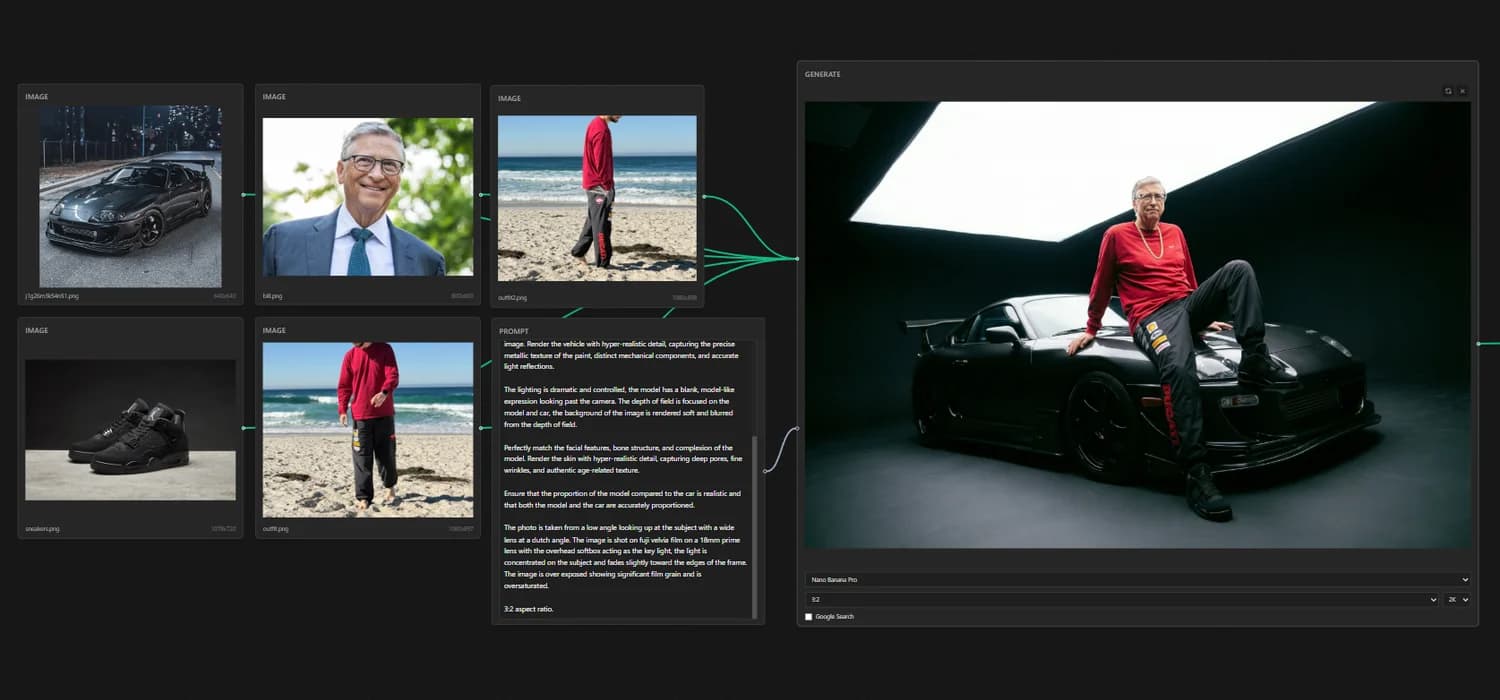
Generate an high fashion photography image of the older man wearing Ducati tracksuit pants, a red long sleeve top, and black sneakers. He should have a gold chain around his neck over top of the red shirt.

The setting is a pristine, high-budget automotive photography studio. The model is sitting casually on the front hood and fender of the car. One leg is dangling down towards the studio floor, while the other leg is pulled up with his foot resting naturally on the car's front bumper. He is leaning back slightly, supporting himself on his hands behind him. A massive softbox downlight (large diffusion bank) hangs directly overhead, creating long, clean highlights on the vehicle. The background is a seamless, dark studio cyclorama. The car is a black mk4 Supra and should match the reference image. Render the vehicle with hyper-realistic detail, capturing the precise metallic texture of the paint, distinct mechanical components, and accurate light reflections.

The lighting is dramatic and controlled, the model has a blank, model-like expression looking past the camera. The depth of field is focused on the model and car, the background of the image is rendered soft and blurred from the depth of field.

Perfectly match the facial features, bone structure, and complexion of the model. Render the skin with hyper-realistic detail, capturing deep pores, fine wrinkles, and authentic age-related texture.

Ensure that the proportion of the model compared to the car is realistic and that both the model and the car are accurately proportioned.

The photo is taken from a low angle looking up at the subject with a wide lens at a dutch angle. The image is shot on fuji velvia film on a 18mm prime lens with the overhead softbox acting as the key light, the light is concentrated on the subject and fades slightly toward the edges of the frame. The image is over exposed showing significant film grain and is oversaturated.

3:2 aspect ratio.
Contact Sheet 1, Fashion Focus
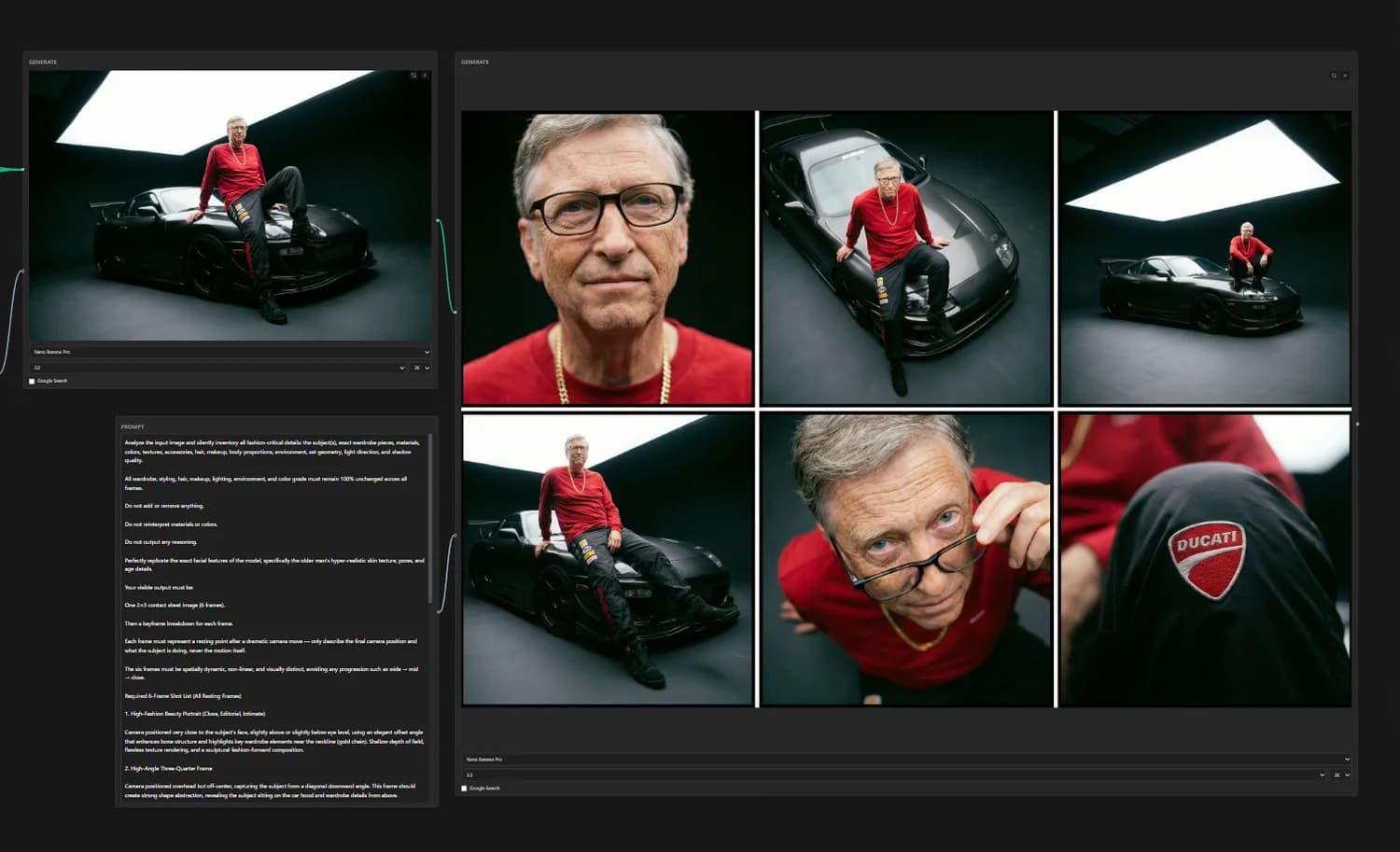
Analyze the input image and silently inventory all fashion-critical details: the subject(s), exact wardrobe pieces, materials, colors, textures, accessories, hair, makeup, body proportions, environment, set geometry, light direction, and shadow quality.

All wardrobe, styling, hair, makeup, lighting, environment, and color grade must remain 100% unchanged across all frames.

Do not add or remove anything.

Do not reinterpret materials or colors.

Do not output any reasoning.

Perfectly replicate the exact facial features of the model, specifically the older man's hyper-realistic skin texture, pores, and age details.

Your visible output must be:

One 2×3 contact sheet image (6 frames).

Then a keyframe breakdown for each frame.

Each frame must represent a resting point after a dramatic camera move — only describe the final camera position and what the subject is doing, never the motion itself.

The six frames must be spatially dynamic, non-linear, and visually distinct, avoiding any progression such as wide → mid → close.

Required 6-Frame Shot List (All Resting Frames)

1. High-Fashion Beauty Portrait (Close, Editorial, Intimate)

Camera positioned very close to the subject’s face, slightly above or slightly below eye level, using an elegant offset angle that enhances bone structure and highlights key wardrobe elements near the neckline (gold chain). Shallow depth of field, flawless texture rendering, and a sculptural fashion-forward composition.

2. High-Angle Three-Quarter Frame

Camera positioned overhead but off-center, capturing the subject from a diagonal downward angle. This frame should create strong shape abstraction, revealing the subject sitting on the car hood and wardrobe details from above.

3. Low-Angle Oblique Full-Body Frame

Camera positioned low to the ground and angled obliquely toward the subject. This elongates the silhouette, emphasizes the footwear and the car bumper, and creates a dramatic perspective distinct from Frames 1 and 2.

4. Wide Environmental Studio Frame

Camera positioned wide and back, capturing the entire profile of the vehicle with the subject sitting on the hood. This frame emphasizes the scale of the "high-budget studio," showing the massive softbox light source hanging above the car and the seamless cyclorama background. The car's sleek lines and reflections are the primary focus, with the subject integrated into the grand scene. The model is squatting on the hood of the car

5. Intimate Close Portrait From high angle

Camera positioned high above the subject's face, looking at a downward angle as if on a boom. The subject has tilted their head back slightly to face upward. With one finger, they are pulling down their glasses to look over top of the rim. Despite facing the camera, their expression remains totally blank and distant, staring past the lens.

6. Extreme Detail Frame From a Non-Intuitive Angle

Camera positioned extremely close to a wardrobe detail, accessory, or texture, but from an unusual spatial direction. This must be a striking, abstract, editorial detail frame.

Continuity & Technical Requirements

Maintain perfect wardrobe fidelity in every frame: exact garment type (Ducati pants, red top), silhouette, material, color, texture, stitching, accessories (gold chain), closures, jewelry, shoes, hair, and makeup.

Environment, textures, and lighting must remain consistent.

Depth of field shifts naturally with focal length (deep for distant shots, shallow for close/detail shots).

Photoreal textures and physically plausible light behavior required.

Frames must feel like different camera placements within the same scene, not different scenes.

All keyframes must be the exact same aspect ratio, and exactly 6 keyframes should be output. Maintain the exact visual style in all keyframes, where the image is shot on fuji velvia film with a hard flash, the light is concentrated on the subject and fades slightly toward the edges of the frame. The image is over exposed showing significant film grain and is oversaturated. The skin appears shiny (almost oily), and there are harsh white reflections on the skin and gold chain.

Output Format

A) 2×3 Contact Sheet Image (Mandatory)
Chill Bill
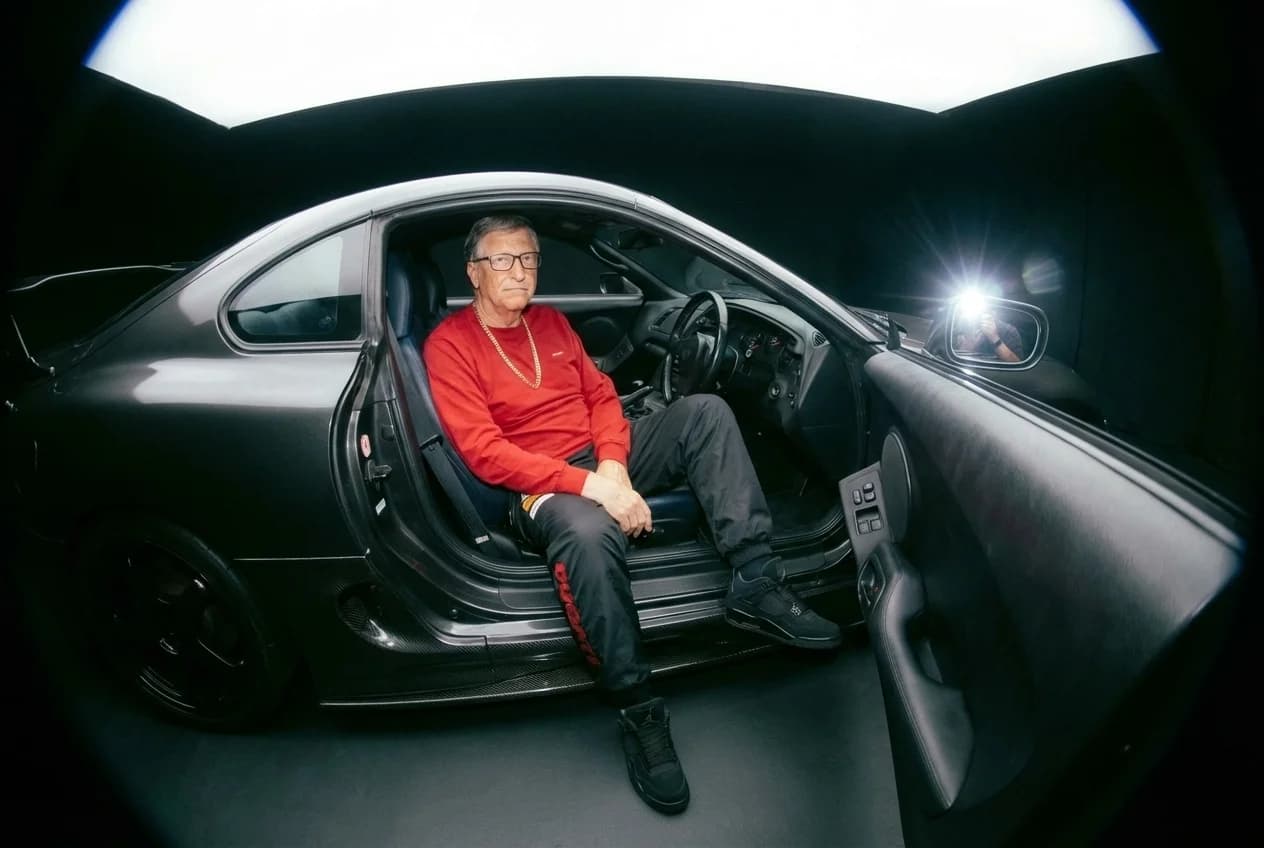
Show me an image of the man sitting in the drivers seat of the car with legs hanging out, he has a relaxed posture and an bored expression as he looks directly into the camera.

Maintain the exact visual style, where the image is shot on fuji velvia film with a hard flash, the light is concentrated on the subject and fades slightly toward the edges of the frame. The image is over exposed showing significant film grain and is oversaturated. The skin appears shiny (almost oily), and there are harsh white reflections on the skin and gold chain.

The image is shot on a wide lens, with visible lens distortion and showing the details of the vehicle and cycolorama environment.

Perfectly match the facial features of the model.

The positioning of the car should be exactly the same as the reference images, but the position of the camera should move to the new angle and focus.

The camera flash and hints of a photographer are visible in the wing mirror of the open door.
Ballmer Cameo
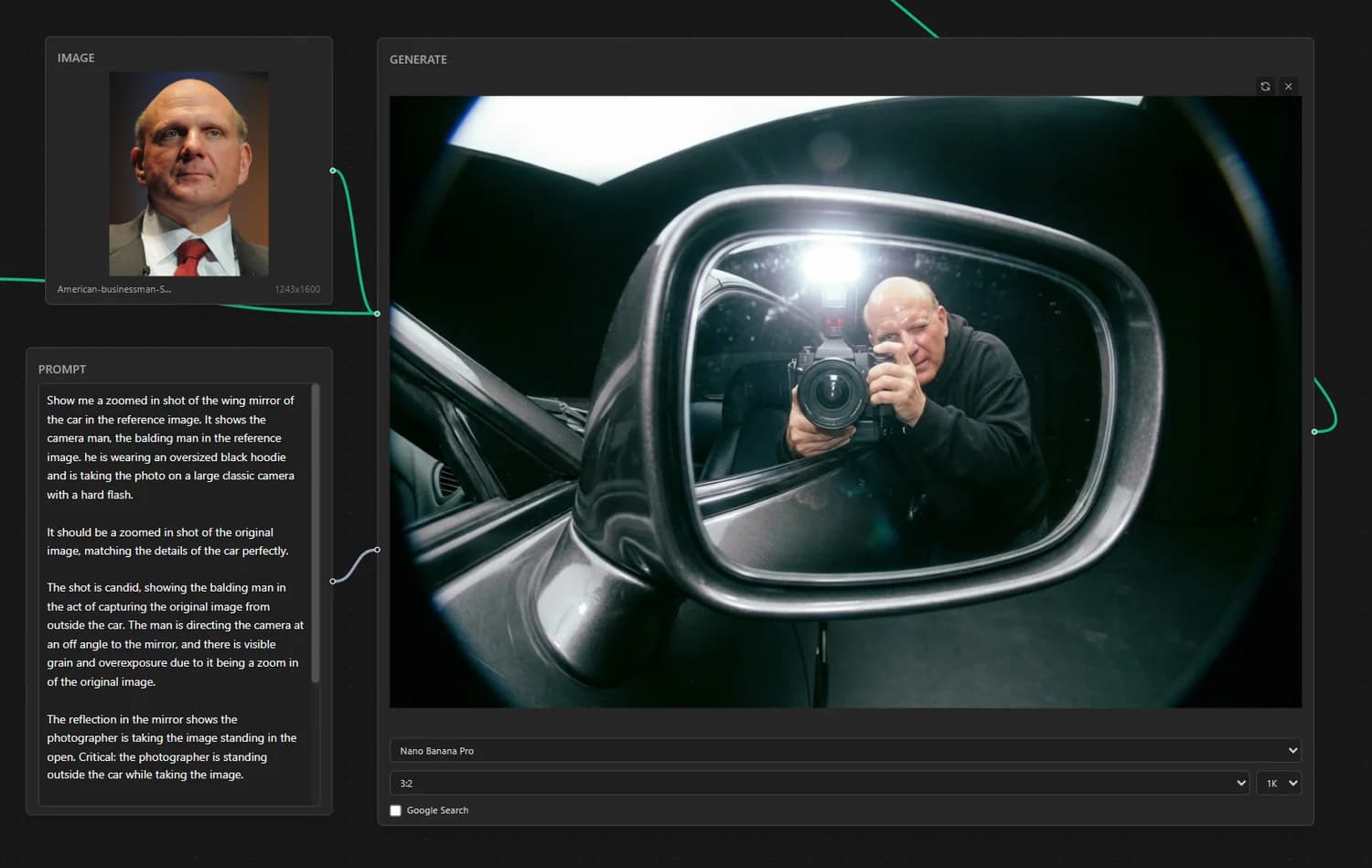
Show me a zoomed in shot of the wing mirror of the car in the reference image. It shows the camera man, the balding man in the reference image. he is wearing an oversized black hoodie and is taking the photo on a large classic camera with a hard flash.

It should be a zoomed in shot of the original image, matching the details of the car perfectly.

The shot is candid, showing the balding man in the act of capturing the original image from outside the car. The man is directing the camera at an off angle to the mirror, and there is visible grain and overexposure due to it being a zoom in of the original image.

The reflection in the mirror shows the photographer is taking the image standing in the open. Critical: the photographer is standing outside the car while taking the image.

Maintain the exact visual style, where the image is shot on fuji velvia film with a hard flash. The image is shot on a fish eye lens with visible vignetting.  The image is over exposed showing significant film grain and is oversaturated. The skin appears shiny (almost oily), and there are harsh white reflections on the skin.

3:2 aspect ratio
Bill Removal
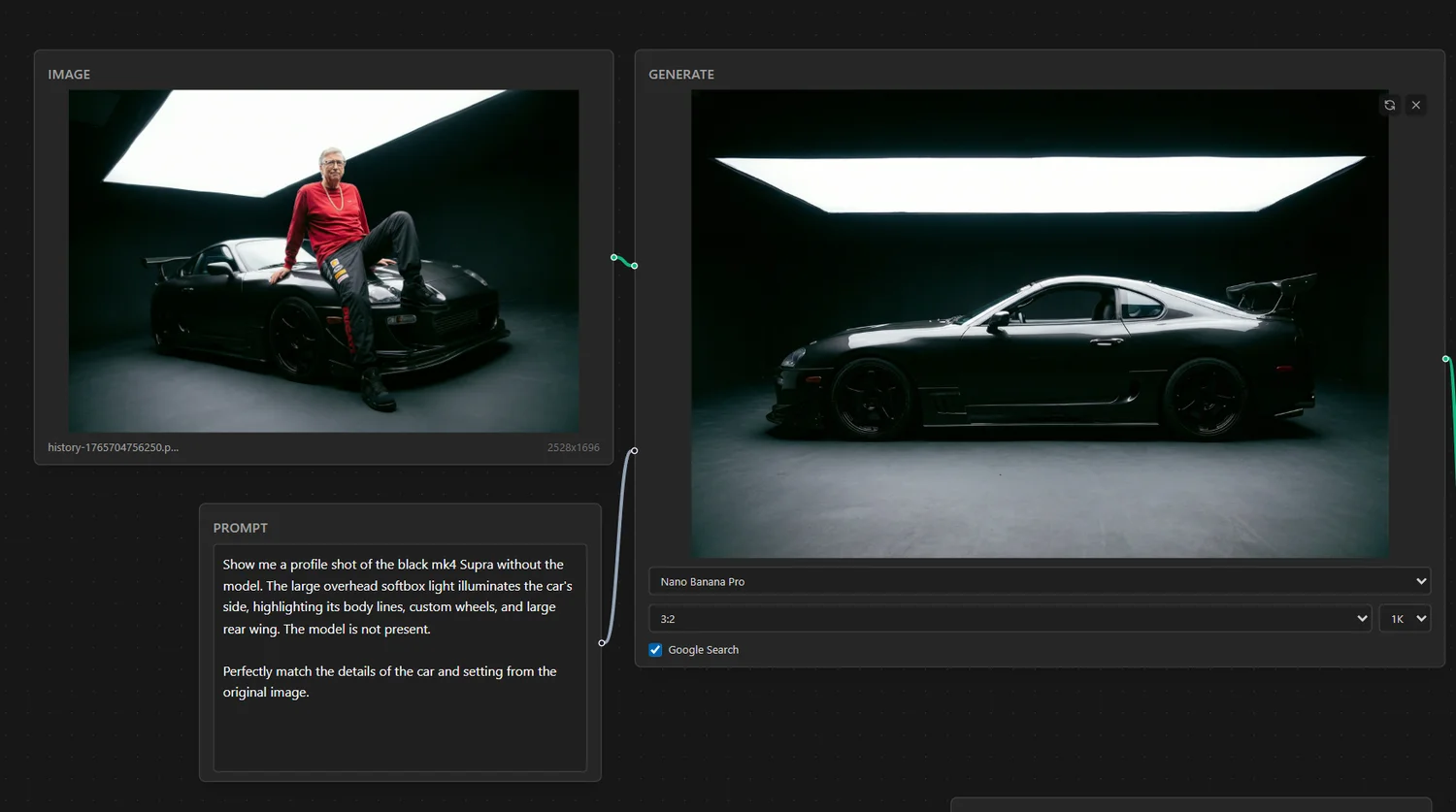
Show me a profile shot of the black mk4 Supra without the model. The large overhead softbox light illuminates the car's side, highlighting its body lines, custom wheels, and large rear wing. The model is not present.

Perfectly match the details of the car and setting from the original image.
Contact Sheet 2
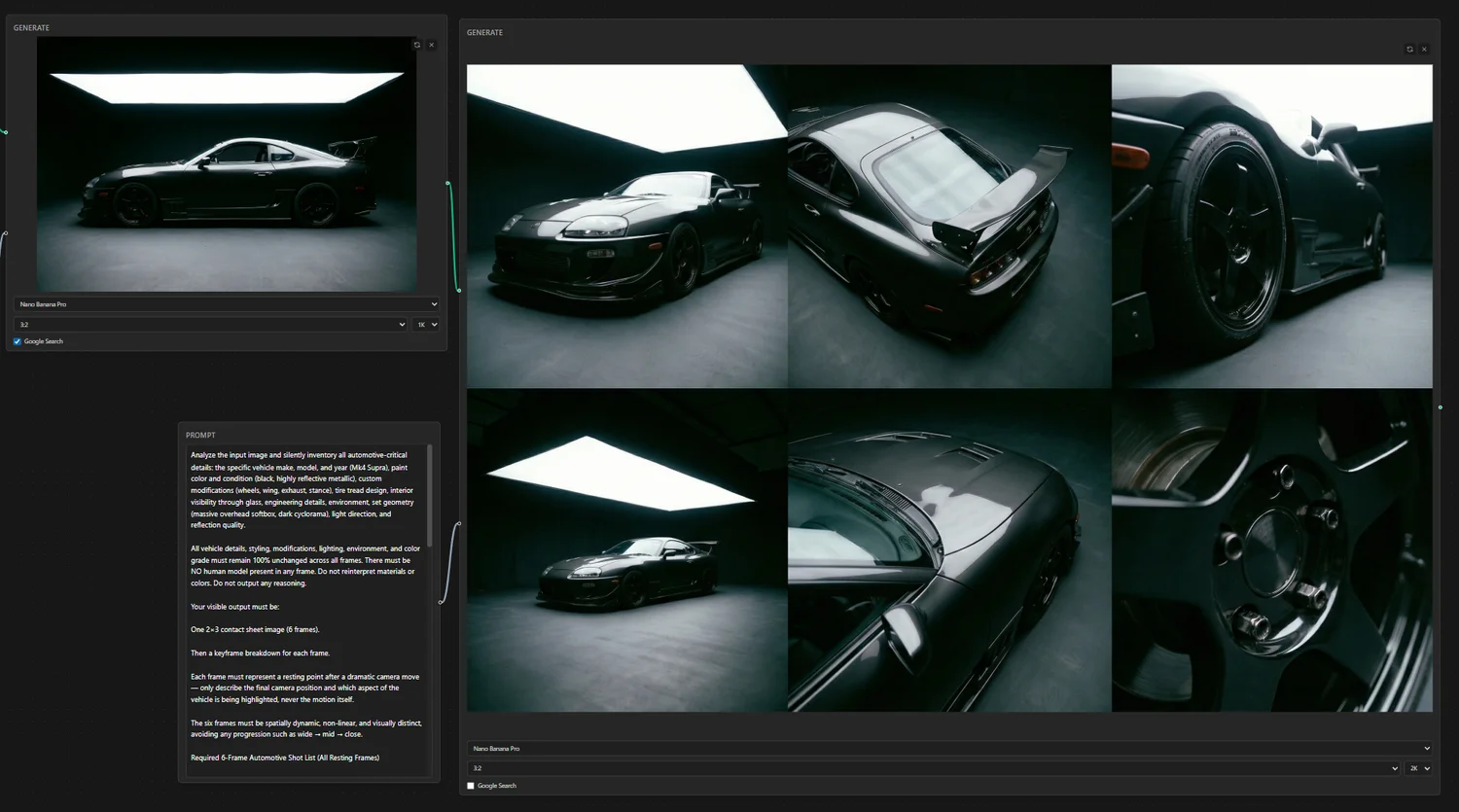
Analyze the input image and silently inventory all automotive-critical details: the specific vehicle make, model, and year (Mk4 Supra), paint color and condition (black, highly reflective metallic), custom modifications (wheels, wing, exhaust, stance), tire tread design, interior visibility through glass, engineering details, environment, set geometry (massive overhead softbox, dark cyclorama), light direction, and reflection quality.

All vehicle details, styling, modifications, lighting, environment, and color grade must remain 100% unchanged across all frames. There must be NO human model present in any frame. Do not reinterpret materials or colors. Do not output any reasoning.

Your visible output must be:

One 2×3 contact sheet image (6 frames).

Then a keyframe breakdown for each frame.

Each frame must represent a resting point after a dramatic camera move — only describe the final camera position and which aspect of the vehicle is being highlighted, never the motion itself.

The six frames must be spatially dynamic, non-linear, and visually distinct, avoiding any progression such as wide → mid → close.

Required 6-Frame Automotive Shot List (All Resting Frames)

1. Low-Angle Front "Hero" Stance (Aggressive, Wide Lens) Camera positioned very low to the studio floor at the front three-quarter view, using a wide-angle lens. This perspective exaggerates the front bumper, headlights, and wide stance of the car, making it appear dominant and aggressive. The massive overhead softbox creates long, sleek highlight lines across the hood and roof.

2. High-Angle Rear Quarter Abstract (Geometric, Sculptural) Camera positioned high overhead, looking down sharply at the rear quarter and wing area. This frame emphasizes the complex geometry of the Supra’s "hips," the curve of the rear windshield, and the imposing structure of the rear wing against the dark studio floor.

3. Ultra-Low "Worm's Eye" Profile (Speed, Texture) Camera placed practically on the ground, looking along the side profile of the car from just behind the front wheel towards the rear. The front wheel and tire dominate the immediate foreground, showing tire sidewall details and brake hardware, while the rest of the car body stretches away into the distance, emphasizing length and low ride height.

4. Wide Environmental Studio Frame (Scale, Production Value) Camera positioned very wide and far back, capturing the entire vehicle small within the vastness of the high-budget studio. This shot must include the massive overhead diffusion bank hanging above the car, showing the scale of the lighting setup against the seamless dark cyclorama infinity background.

5. The "Driver's Line" Abstract (Curvature, Reflection) Camera positioned near the base of the windshield (cowl area), looking forward down the length of the long hood and front fender curve. This is a non-traditional angle that focuses on the landscape of the car's bodywork and the precise reflection of the overhead light source on the black paint.

6. Macro Engineering Detail (Texture, Precision) Extreme close-up macro shot focusing on a specific, intricate detail—such as the internal elements of the headlight projector, the texture of the carbon fiber on the wing, or the lug nuts and center cap of the wheel. The focus must be razor-sharp on the metallic and glass textures.

Continuity & Technical Requirements

Maintain perfect vehicle fidelity in every frame: exact paint finish, modifications, wheels, tires, and cleanliness.

Environment, textures, and massive overhead lighting source must remain consistent.

Depth of field shifts naturally with focal length (deep for wide/environmental shots, very shallow for macro/detail shots).

Photoreal textures and physically plausible light behavior (especially metallic paint reflections and glass refractions) required.

Frames must feel like different high-end camera placements within the same shoot.

All keyframes must be the exact same aspect ratio, and exactly 6 keyframes should be output. Maintain the exact visual style in all keyframes: shot on Fuji Velvia film with a hard light source creating high contrast, overexposed highlights showing significant film grain, and oversaturated colors. The black paint should look deep and wet, with harsh white reflections from the light source.

Output Format A) 2×3 Contact Sheet Image,
Typography
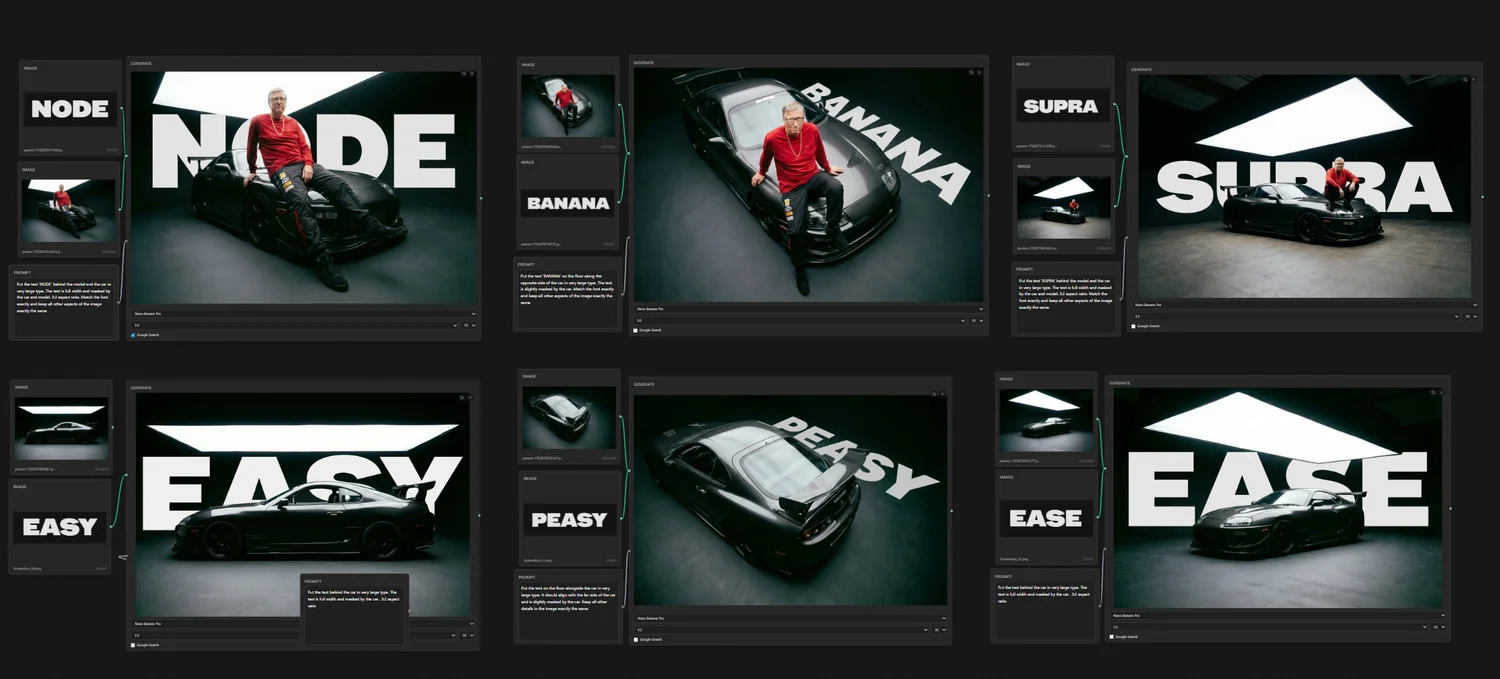
Put the text 'NODE' behind the model and the car in very large type. The text is full width and masked by the car and model. 3:2 aspect ratio. Match the font exactly and keep all other aspects of the image exactly the sameImage to Video Prompts
For the image to video prompts, prompt to minimise movement in the model and to focus on large smooth movements in the camera. This suits the easing much better.
The camera smoothly and slowly pushes in on the models shirt. The model's movements are extremely deliberate and precise. The text 'SUPRA' disappears in a folding animation.The camera smoothly and slowly dollys out to show the profile of the car. The scene is static and frozen. The car is totally motionless. The text appears behind the car in a smooth blur reveal.The camera smoothly and slowly pushes in on a boom. The model stays in the same position on the hood, only looking up to lower his glasses. His movements are extremely deliberate and precise